




Content in This Volume
About the Book
Using objective and rigorous analysis, and written for a broad range of policymakers, investors, industry experts, decision makers, academics, researchers, conservation and development practitioners, and captive ape and animal welfare practitioners, this publication is intended to influence debate, practice and policy toward reconciling ape conservation and welfare with economic and social development.
Read MoreExecutive Summary
A high-level overview of the book aimed at giving the reader an impression of the scope and depth of its content, the executive summary introduces the illegal ape trade topic and describes the key reasons it occurs, ways it impacts apes and habitats, and interventions to tackle it.
Read MoreFull Text: Volume IV
This volume focuses on the impact of the killing, capture and trade in apes on ape survival and welfare. It features in-depth analysis of ape hunting and trade, the impact of these activities on wild ape populations and captured individuals, relevant legal and regulatory frameworks, cultural and socioeconomic drivers of ape hunting and trade, and responses to these drivers, including conservation initiatives and law-enforcement efforts.
Download Full BookOverview, Credits, Foreword, Notes, Acknowledgments
The preliminary pages of Volume IV include an overview of its contents, a foreword, and acknowledgment of the people who made the publication possible.
Download PDFForeword
The foreword to this volume, written by Nadya Hutagalung, actress and celebrity ambassador for the UN Environment Programme and its Great Apes Survival Partnership, addresses the overall themes raised in the subsequent chapters, focusing on how the hunting, killing, capture or trade in apes has severe impacts at both the individual and species levels, and concluding that “their survival is, quite literally, in our hands”.
Read MoreApes Overview
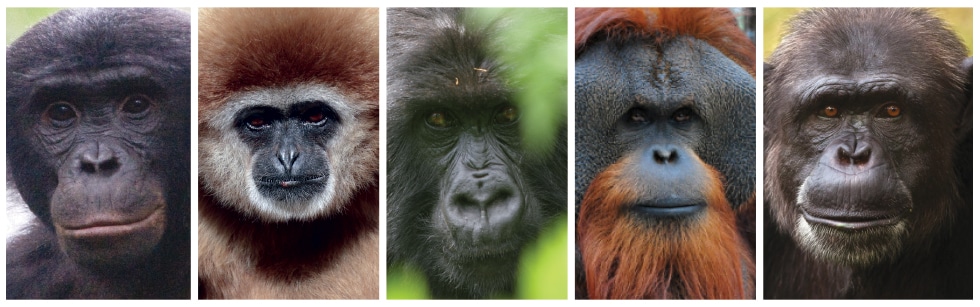
The overview provides a brief description of each great ape and gibbon species, as well as a detailed explanation of their socioecology, a table of their common and scientific names and the countries in which they are found, and maps showing their distribution.
Read MoreIntroduction to Section 1: Killing, Capture, Trade and Conservation
The introduction provides an overview of ape killing, capture and trade, an analysis of the purposes for which apes are used, and a summary of the drivers and impacts of the trade. It also situates this issue within the larger picture of the global wildlife trade and provides highlights of each chapter.
Read MoreCh 1: The Impact of Killing, Capture and Trade on Apes and Their Habitat
Chapter 1 assesses the direct and indirect impacts of ape killing and capture, explores why apes are especially vulnerable to hunting, and describes the risks of hunting to human health. It also identifies knowledge gaps that must be filled to tackle the threats effectively.
Read MoreCh 2: Understanding and Responding to Cultural Drivers of the Ape Trade
Chapter 2 explores cultural drivers of the ape trade, focusing on the knowledge, attitudes, beliefs and practices of local human communities in places where nonhuman apes live. It also discusses various responses to these cultural drivers and presents four case studies demonstrating both the negative and positive impacts that cultural beliefs and practices can have on ape populations.
Read MoreCh 3: Socioeconomics and the Trade in Ape Meat and Parts
Chapter 3 outlines the history of ape hunting as well as the scale and consequences of the trade in ape meat and parts in Africa and Southeast Asia. It details the socioeconomic drivers of wild meat hunting and, due to availability of information, focuses more on great apes than gibbons. It also explores barriers and potential solutions to curbing the wild meat trade.
Read MoreCh 4: Drivers of the Illegal Trade in Live Apes
Chapter 4 examines key drivers of the live ape trade, including the role of Chinese zoos, Thai and U.S. marketing and entertainment industries, and Indonesian Borneo’s pet orangutan market. It also discusses the role of social media as a driver and enabler of the trade and potential ways it can be used to curb it.
Read MoreCh 5: Curbing the Illegal Killing, Capture and Trade in Apes: Responses at Source
Chapter 5 discusses strategies to tackle the illegal ape trade at its source, focusing on four key approaches: reducing demand for illegal products, creating effective legal frameworks, strengthening law enforcement and promoting community engagement. In addition to presenting a series of case studies and relevant tools and resources, it also explores how these approaches are connected—and their social and ecological implications.
Read MoreCh 6: Protecting Apes: The Legal and Regulatory Environment
Chapter 6 focuses on legal and regulatory frameworks within which ape hunters, traders and consumers operate, and considers how they may be applied to prohibit the trade. This includes an exposition of national and international laws governing species protection, and a detailed analysis of relevant legislation in 17 ape range states.
Read MoreIntroduction to Section 2: The Status and Welfare of Great Apes and Gibbons
The Introduction to Section 2 provides an overview of the section and its chapters, which focus on the status of ape populations in their natural habitat, the relevance of evidence-based approaches to conservation, the fight for personhood and rights for nonhuman animals, and the status of apes in captivity.
Read MoreCh 7: The Status of Apes: A Foundation for Systematic, Evidence-based Conservation
Chapter 7 presents broad abundance estimates for apes, reviews the main threats to all ape species and examines the history of surveying apes. It also provides an overview of current survey methodology and promising innovations, highlights the advantages of evidence-based conservation frameworks and evaluation, and presents several partnerships and databases that have formed to promote data-sharing.
Read MoreCh 8: The Campaign for Nonhuman Rights and the Status of Captive Apes
Chapter 8 explores the fight for personhood and rights for nonhuman animals, providing a review of progress and challenges to date. It also updates and broadens captive ape statistics included in each volume of the State of the Apes series.
Read MoreAnnexes
Annexes I-IX include IUCN Red List criteria, an overview of WildAid’s campaigns to reduce demand for wildlife products in Asia, threats to African great apes, recent African great ape population estimates and trends, past and current Asian great ape population and decline estimates, and gibbon population estimates, among other topics.
Read MoreEndpages
The endpages include Acronyms and Abbreviations, Glossary, References and Index.
Download Full DocumentApe Population Abundance Estimates
This 2020 online-only annex presents ape population abundance estimates at the level of a protected area and/or its buffer zone, a logging concession or group of concessions, or any discrete area where a survey has taken place in the past two decades.
Read MorePolicy Briefing
This briefing, aimed at policymakers and those in positions of authority for implementation of legislation and regulations, presents recommendations to achieve a balance between socio-economic interests, ape conservation and community livelihoods.
Read More