

State Of The Apes

  • Home
  • Volumes
    Toggle submenu
    • Volume I - Extractive Industries
    • Volume II - Industrial Agriculture
    • Volume III – Infrastructure Development
    • Volume IV - Killing, Capture and Trade
    • Volume V – Disease, Health and Ape Conservation
  • Resources
    Toggle submenu
    • Reports
    • Videos
  • Languages
    Toggle submenu
    • Français
    • Bahasa Indonesia
    • 中文
  • Partners
Toggle Menu

Flyout Menu

  • Home
  • Volumes
    Toggle submenu
    • Volume I - Extractive Industries
    • Volume II - Industrial Agriculture
    • Volume III – Infrastructure Development
    • Volume IV - Killing, Capture and Trade
    • Volume V – Disease, Health and Ape Conservation
  • Resources
    Toggle submenu
    • Reports
    • Videos
  • Languages
    Toggle submenu
    • Français
    • Bahasa Indonesia
    • 中文
  • Partners

Home » Volume 4

Ch 1: The Impact of Killing, Capture and Trade on Apes and Their Habitat

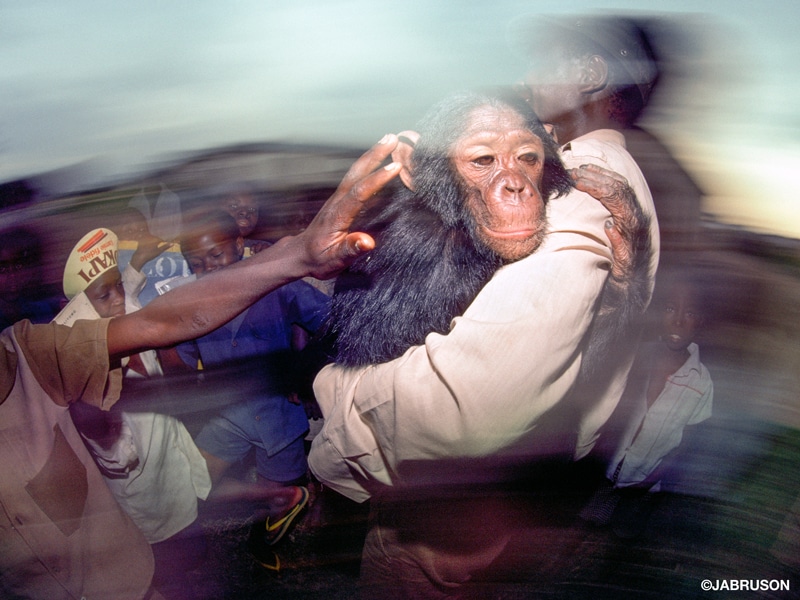
A chimpanzee clings to a national park guard as a group of children stand nearby and one extends an arm toward the ape

Facebooktwitterby feather
Download Full Chapter

The hunting of apes is not a new threat. What is new is its scale—despite its illegality in all range states—and the profound depletion of ape populations.

People kill apes for various reasons, including for their meat and parts, to protect their crops or property from real or perceived threat, to feel safer, for sport, and to capture infants for the live animal trade. The live trade supplies apes as pets, zoo animals, photo props and other tourism accessories, and attractions for amusement parks and other entertainment venues.

Hunting is one of the most important drivers of apes’ extinction in the wild, exacerbating other contributing factors such as their generally low reproductive rates and the length of time it takes them to mature. Even when an ape is not killed, ape hunting can have long-term consequences for survivors, including injury, and psychological and socioecological effects.

Local ape decline or extinction can reduce seed dispersal, which is critical to maintaining tree species diversity and ecosystem health. And, by hunting nonhuman apes, people can expose themselves and other apes to disease, which can have serious implications for public health.

Given that the International Union for Conservation of Nature (IUCN) lists all ape species as either “critically endangered” or “endangered”—except for the “vulnerable” eastern hoolock (Hoolock leuconedys)—the scale of hunting is a key determinant of their survival in the wild. But more data is needed to accurately assess the scale of ape hunting and to predict its impact on the long-term survival of intact populations.

  • Download

To purchase State of the Apes

Purchase from Cambridge University Press

To purchase State of the Apes

Purchase from Amazon

To purchase State of the Apes

Purchase from Barnes and Noble

To purchase State of the Apes

Purchase from Amazon Purchase from Cambridge University Press Purchase from Barnes and Noble
Arcus Foundation
U.S. Office

Phone: +1-212-488-3000

U.K. Office

Phone: +44-1223-653040

Subscribe to Arcus Emails

More Information

contact@arcusfoundation.org

Arcus Foundation

Great Apes & Gibbons Program
  • Visit us on Facebook
  • Visit us on Instagram
  • Visit us on LinkedIn

Privacy | Terms