

State Of The Apes

  • Home
  • Volumes
    Toggle submenu
    • Volume I - Extractive Industries
    • Volume II - Industrial Agriculture
    • Volume III – Infrastructure Development
    • Volume IV - Killing, Capture and Trade
    • Volume V – Disease, Health and Ape Conservation
  • Resources
    Toggle submenu
    • Reports
    • Videos
  • Languages
    Toggle submenu
    • Français
    • Bahasa Indonesia
    • 中文
  • Partners
Toggle Menu

Flyout Menu

  • Home
  • Volumes
    Toggle submenu
    • Volume I - Extractive Industries
    • Volume II - Industrial Agriculture
    • Volume III – Infrastructure Development
    • Volume IV - Killing, Capture and Trade
    • Volume V – Disease, Health and Ape Conservation
  • Resources
    Toggle submenu
    • Reports
    • Videos
  • Languages
    Toggle submenu
    • Français
    • Bahasa Indonesia
    • 中文
  • Partners

Home » Volume 1

Ch 6: Artisanal and Small-Scale Mining

Chapter_6
Facebooktwitterby feather
Download Full Chapter

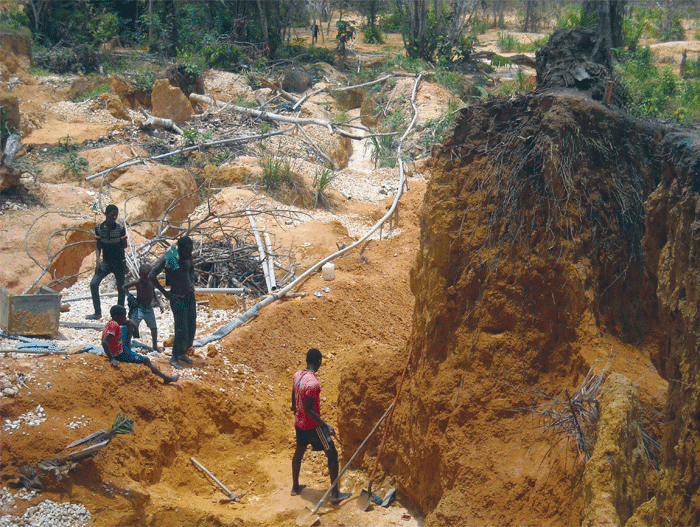
An increasing threat to tropical ecosystems is posed by artisanal and small-scale mining (ASM) for high-value minerals including diamonds, gold, tungsten, and coltan (a source of tantalum, used in cell-phone circuitry). ASM poses many of the same risks as industrial mining, including habitat destruction and fragmentation, pollution, and hunting pressure on wild animals. But while large-scale mining requires formal concessions and at least some measure of supervision by national or international authorities, ASM is generally informal and either illegal or a-legal, outside any regulatory framework. Where regulations exist they may be ignored or unenforced owing to corruption or lack of capacity and resources. The miners themselves are often exploited by the traders they sell to and unaware of the dangers of the use of toxic chemicals including mercury and cyanide. Additionally, mining camps in remote areas may serve as bases for illegal activities such as ivory poaching, bushmeat hunting, and live-animal capture.

Various strategies have been proposed to mitigate the impact of ASM. Where it occurs illegally in formally protected habitat, eviction by force is the most direct approach, but keeping miners out permanently may not be possible. Without a robust program offering miners an alternative livelihood and/or an economic stake in respecting the borders of the protected area, eviction is likely to fail. In areas where mining is legal, valid approaches include negotiating access under rules established to minimize ecological disruption and incentives for responsible practices. Even small changes can greatly ameliorate negative impacts.

  • Download

To purchase State of the Apes

Purchase from Cambridge University Press

To purchase State of the Apes

Purchase from Amazon

To purchase State of the Apes

Purchase from Barnes and Noble

To purchase State of the Apes

Purchase from Amazon Purchase from Cambridge University Press Purchase from Barnes and Noble
Arcus Foundation
U.S. Office

Phone: +1-212-488-3000

U.K. Office

Phone: +44-1223-653040

Subscribe to Arcus Emails

More Information

contact@arcusfoundation.org

Arcus Foundation

Great Apes & Gibbons Program
  • Visit us on Facebook
  • Visit us on Instagram
  • Visit us on LinkedIn

Privacy | Terms