



Content in This Volume
About the Book
Intended for a broad range of policy makers, industry experts, decision makers, academics, researchers, and NGOs, these publications aim to influence debate, practice, and policy, seeking to reconcile ape conservation and welfare with economic and social development, through objective and rigorous analysis.
Read MoreExecutive Summary
This volume draws attention to the evolving context within which great ape and gibbon habitats increasingly interface with extractive industries. It identifies complementary objectives and mutually acceptable trade-offs and compromises that seek to reconcile ape conservation and welfare with economic and social development.
Download PDFFull Text: Volume I
This volume draws attention to the evolving context within which great ape and gibbon habitats increasingly interface with extractive industries. It identifies complementary objectives and mutually acceptable trade-offs and compromises that seek to reconcile ape conservation and welfare with economic and social development.
Download PDFOverview, Credits, Foreword, Notes, Acknowledgments
The preliminary pages include an overview of the contents; a foreword from Zhang Xinsheng, president of the International Union for Conservation of Nature; notes to readers; and acknowledgment of the people who made the publication possible.
Download PDFIntroduction
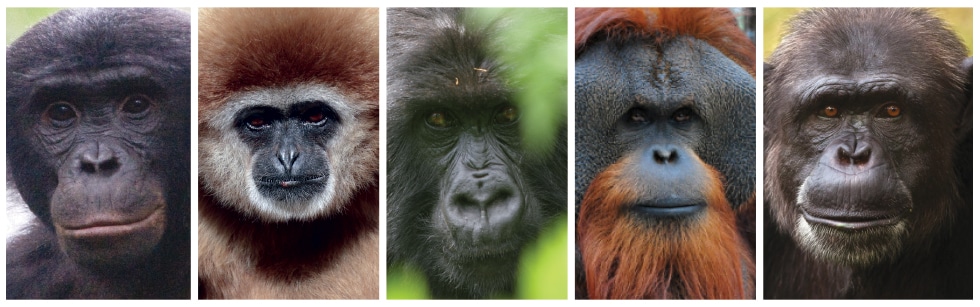
This introductory chapter provides a brief overview of great apes and gibbons; our definition of extractive industries and summary highlights of each chapter that illustrate the context in which extractive industries operate and the linkages to ape conservation.
Read MoreCh 1: Global Drivers
The greatest threats to the conservation of great apes and gibbons are habitat loss and poaching. Ape habitat is subject to fragmentation and degradation by logging, agriculture, mining and expanded human settlement. Wild populations are at risk from human predation, the live pet trade, and the spread of human diseases.
Read MoreCh 2: Land Tenure
While as much as 12 percent of the land on Earth has been set aside for conservation, global biodiversity continues to decline. Ape habitat is particularly vulnerable, as it is predominantly hemmed in and fragmented by agricultural land and subject to legal or illegal logging and mining, even in areas that are ostensibly protected.
Read MoreCh 3: Ecological Impacts
Logging and mining pose obvious threats to wildlife habitat, but their impact on ape populations is not fully understood. The socioecology of great apes contributes to their vulnerability: they reproduce slowly, are sensitive to human intrusion, and nest and forage in trees. But some species and some environments are more sensitive than others.
Read MoreCh 4: Industrial Timber Extraction
The best approach to ape conservation is to preserve their habitat intact and undisturbed. But as economic pressure on tropical forests is likely to increase in the foreseeable future, preserving ape habitat will therefore depend on stopping the most destructive practices, such as clear felling, and implementing sustainable forestry management.
Read MoreCh 5: Industrial Mining, Oil and Gas
The effects of mining, including oil and gas production, on ape habitat and populations has been little studied until now, but there is cause for concern. A recent survey related to 27 ape species revealed that mining projects were planned or underway within the ranges of all but five of them.
Read MoreCh 6: Artisanal and Small-Scale Mining
An increasing threat to tropical ecosystems is posed by artisanal and small-scale mining for high-value minerals including diamonds, gold, tungsten and coltan. ASM poses many of the same risks as industrial mining.
Read MoreCh 7: Indirect Impacts
Clearing forests for logging, mining or agriculture poses a direct threat to ape populations. But the indirect threats of habitat degradation and fragmentation may be the greater danger. Road-building gives access to remote forest areas, creating impacts that extend far beyond the industrial footprint.
Read MoreCh 8: Range State Responses
Guinea, Gabon and Indonesia all have significant populations of apes within their borders, overlapping or bordering with important mineral, timber or agricultural resources. In response to political concerns, both national and international, each has begun to take biodiversity into account for future development.
Read MoreCh 9: Global Distribution and Environmental Conditions
Competition for space and resources between apes and humans is a driving factor in the disappearance of ape habitat and populations, and so is direct human predation on apes, in areas where commercial and/or subsistence hunting is still a significant source of protein. These factors must be considered to conserve ape populations in the wild.
Read MoreCh 10: Apes in Captivity and Extractive Industry
Regulating the treatment of apes in captivity is an ethical issue and an important aspect of conserving apes in the wild. Thousands of wild apes are illegally captured each year, for pets, as performers in circuses and shows and for exhibition in zoos. This contributes to the decline in wild populations.
Read MoreAnnex IV: Ape Population Abundance Estimates
In this annex, ape abundance estimates (2013) are presented at site level, where “site” is a protected area and its buffer zone; a logging concession or group of concessions; or any discrete area where a survey has taken place in the last two decades. Annex IV is available for download below.
Download PDF